This is the ninth part of a series of articles on the relationship between jazz and comic books. Go to Part 1 , Part 2, Part 3, Part 4, Part 5, Part 6, Part 7 or Part 8

In this segment we will focus on two works, which illustrate the intrinsic relationship between comic books and jazz. The first one is the groundbreaking album The Epic (2015), by Kamasi Washington, jazz saxophonist, composer, and bandleader. He gained widespread acclaim for his contributions to the album To Pimp a Butterfly by Kendrick Lamar (2015).

The Epic solidified the reputation of Washington as a leading figure in contemporary jaz, known for revitalizing the interest in jazz among younger audiences with his ambitious, expansive compositions. The vinyl edition of the album is truly a captivating experience, designed to immerse the listener in an adventure that unfolds across multiple discs.

Each of the LPs represent a new chapter in the musical journey, accompanied by striking black and white photography that beautifully captures the essence of the Afrocentric free jazz aesthetic embodied by influential labels such as Tribe, Strata, and Black Jazz. This approach not only elevates the auditory experience but also adds a visual dimension to the storytelling woven into the music.

The Epic box set also included an graphic novel-inspired collection of images, exploring the conceptual narrative that underpins the compositions, offering enthusiasts a deeper understanding of the creative vision behind the album.

And The Epic continues to resonate. In recent years, Washington has been working on a graphic novel: “I had a dream [with] a story that encompassed all the songs [on The Epic], which really led me to have the conviction that I was really going to put it out. So I’m creating a graphic novel for that.”

The second graphic novel we would like to highlight is Instrumental (2017), by Dave Chisholm, a tale about the transformative power of music, weaving together themes of passion, struggle, and artistic expression.

The graphic novel “Instrumental” by Dave Chisholm offers a compelling journey into the emotional and creative depths of its characters. Chisholm, recognized as an acclaimed jazz musician, skillfully shines a spotlight on the intricate and profound experiences encountered by the characters within the narrative. Described as a high-spirited, suspenseful, formally inventive, and visually musical masterpiece, “Instrumental” delivers an epic yet intimate exploration of our relentless longing and search for what lies ahead.

The graphic novel intricately weaves together elements of music, storytelling, and artistry to create a truly immersive and captivating reading experience. It includes a download of an original jazz soundtrack, composed and performed by the author Dave Chisholm. As readers delve into the pages of this remarkable work, they are treated to a fusion of visual art and musical composition that enhances and enriches the narrative, resulting in a multidimensional journey.

The inclusion of the original jazz soundtrack not only adds an auditory layer to the reading experience but also serves as a testament of the multifaceted talent of Chisholm. As with the work of Washington, the innovative approach underscores the interconnectedness of commic ast and jazz, offering a one-of-a-kind opportunity to engage with narratives that transcends traditional boundaries.

Both works invite the readers/listeners to experience the power of storytelling through a harmonious convergence of music and visual art.

Be seeing you!

G.F

This is the eigth part of a series of articles on the relationship between jazz and comic books. Go to Part 1 , Part 2, Part 3, Part 4, Part 5, Part 6 or Part 7.

The present segment of this series of articles on Comics and Jazz proposes a comparative reflection on how comics and jazz went from being marginalized forms of expression to becoming items of interest to collectors.

The changing of jazz from its humble origins to a cultural phenomenon associated with sophistication and elegance is a testament to the complex dynamics of cultural appropriation and reinterpretation. In the early 20th century, jazz was gaining popularity and recognition as a distinct musical genre.

Originating in the African-American communities of New Orleans, jazz drew upon diverse musical influences, including African rhythms, blues, and ragtime. Its infectious rhythms and improvisational nature quickly captured the hearts of music enthusiasts around the world, propelling it into the mainstream.

Jazz became synonymous with freedom of expression and individuality, reflecting the cultural and social changes of the time. The lively syncopated rhythms and soulful melodies not only entertained but also challenged traditional musical conventions, paving the way for experimentation and innovation in the arts.

As jazz diversified, it gave birth to various subgenres, from swing and bebop to fusion and Latin jazz, demonstrating its versatility and adaptability across different cultural and geographical contexts. Its cultural significance also grew, attracting the attention of music enthusiasts. Over time, the historical value and artistic merit of jazz recordings, memorabilia and artifacts continue to captivate aficionados.

The trajectory of jazz bears a striking resemblance to the journey of the comic art, often referred to as the Ninth Art. In their early days, comic books faced significant challenges in being taken seriously as a form of artistic and literary expression. They were often dismissed as mere entertainment for children and adolescents, lacking the depth and complexity attributed to traditional forms of literature and art.

A notorious case of persecution of comics was that of the so-called Comics Code, a pivotal moment in the history of comic book censorship and regulation.

The Comics Code Authority (CCA) was established in 1954 as a direct response to the growing unease surrounding the content portrayed in comic books during that time. A series of Senate hearings and the release of the book, “Seduction of the Innocent” by psychiatrist Fredric Wertham sparked a moral panic and heightened concerns about the potential negative impact of comic books on readers, particularly the youth.

These events culminated in the implementation of the Comics Code Authority, which aimed to regulate and censor the content of comic books to ensure compliance with specified standards. This self-regulatory body was created by the Comics Magazine Association of America and aimed to give guidance to publishers about the content of comic books.

The CCA established a set of stringent guidelines that prohibited the portrayal of graphic violence, gore, and overtly sexual content in comic books. Publishers were required to submit their work to the CCA for approval, and only those publications that adhered to the guidelines were allowed to display the CCA “seal of approval” on their covers.

Many retailers would only stock comic books that bore the CCA seal. This meant that publishers had to comply with their regulations in order to have their products reach a wide audience. However, over time, the CCA faced criticism for being overly restrictive and stifling creativity in the comic book industry. This led to a decline and by the early 2000s, most major publishers had abandoned the CCA seal in favor of their own rating systems or no ratings at all, as the perception of comic books began to shift.

A key factor that contributed to the recognition of comic books as a legitimate art form was the emergence of critical and academic discourse that analyzed and celebrated the medium. Scholars and cultural critics delved into the thematic, aesthetic, and sociocultural dimensions of the comic art, exploring their ability to address complex issues, convey poignant narratives, and provide profound social commentary.

Furthermore, universities and educational institutions began incorporating comic studies into their curricula, offering courses that examined the history, theory, and cultural significance of this unique form of visual storytelling. This shift not only validated the artistic and literary merits of comic books but also fostered a new generation of creators and scholars.

The shift of comic books and jazz from marginalized forms of expression into products that are symbols of consumption and status unfolds as a complex interplay of cultural influences and the ever-evolving dynamics of the cultural industry. It also provides valuable insights into the changing aspects of status symbols and how the value of a product is the result of a social construction. Furthermore, it prompts critical examinations of the forces at play in the commodification of art in contemporary society.

Be seeing you!

G. F.

This is the seventh part of a series of articles on the relationship between jazz and comic books. Go to Part 1 , Part 2, Part 3, Part 4, Part 5 or Part 6.

The parallel between comics and jazz in their embrace of cultural plurality highlights the significance of artistic expression in challenging societal norms and fostering greater understanding and appreciation for diverse cultural perspectives. From the iconic artwork on jazz album covers to posters promoting live performances, the visual representations of the jazz culture created a compelling visual narrative that parallels the sonic experience.

The premise of this series of articles is that a large part of the aesthetics of jazz comes from the Graphic Arts, while the Ninth Art finds a source of inspiration in the genre. Both mediums have the capacity to empower and amplify voices that are often underrepresented, and both are privileged fields for observing gender issues, which is the main point of the present segment.

When it comes to comic books, the portrayal of gender roles and stereotypes has been a subject of debate. From the early days of the comic book industry, female characters were often relegated to stereotypical roles such as “damsels in distress” or sidekicks to their male counterparts.

Although in recent years there has been a noticeable shift towards creating more diverse and empowering female characters, challenging traditional gender norms within the genre, there is still a lot of room development in this area.

Similarly, in the realm of jazz, there has been a long history of male dominance, with female musicians often facing discrimination and gender-based barriers in pursuing their careers. Despite these challenges, there have been many influential female jazz musicians who have made a lasting impact on the genre, breaking through the traditional gender norms and paving the way for future generations of women in jazz.

While achievements in the field of women’s rights gain visibility outside the limits of representation (to use an expression from the French philosopher Michel Foucault), female protagonism still encounters a certain barrier in transposition into the language of comic books. Biographical graphic novels are a good example of how representation can both promote advances, but also hinder them.

When examining the portrayal of male and female characters in graphic novels, it becomes evident that these depictions often intertwine with and reflect the pervasive elements of the sexist social structure within which we exist. Particularly noteworthy is the prevalence of extremely eroticized bodies among the heroines in the superhero comics niche.

This trend not only perpetuates unrealistic and hypersexualized standards of beauty, but also perpetuates gender stereotypes and reinforces the objectification of female characters within the medium. These portrayals can serve to underscore the need for a more progressive and inclusive approach to character representation within graphic novels, one that embraces diversity, rejects traditional gender norms, and strives for more authentic and multidimensional characterizations.

It is also often observed that representations tend to focus more on personal scandals rather than on the professional achievements of these remarkable women. This imbalance can lead to a skewed perception of their contributions to the world of jazz and their impact on the broader cultural landscape. Furthermore, such stereotypes have detrimental effects on the visibility and appreciation of women in music in general and particularly in jazz, and their importance to the history of the genre, overlooking and or undervaluating it.

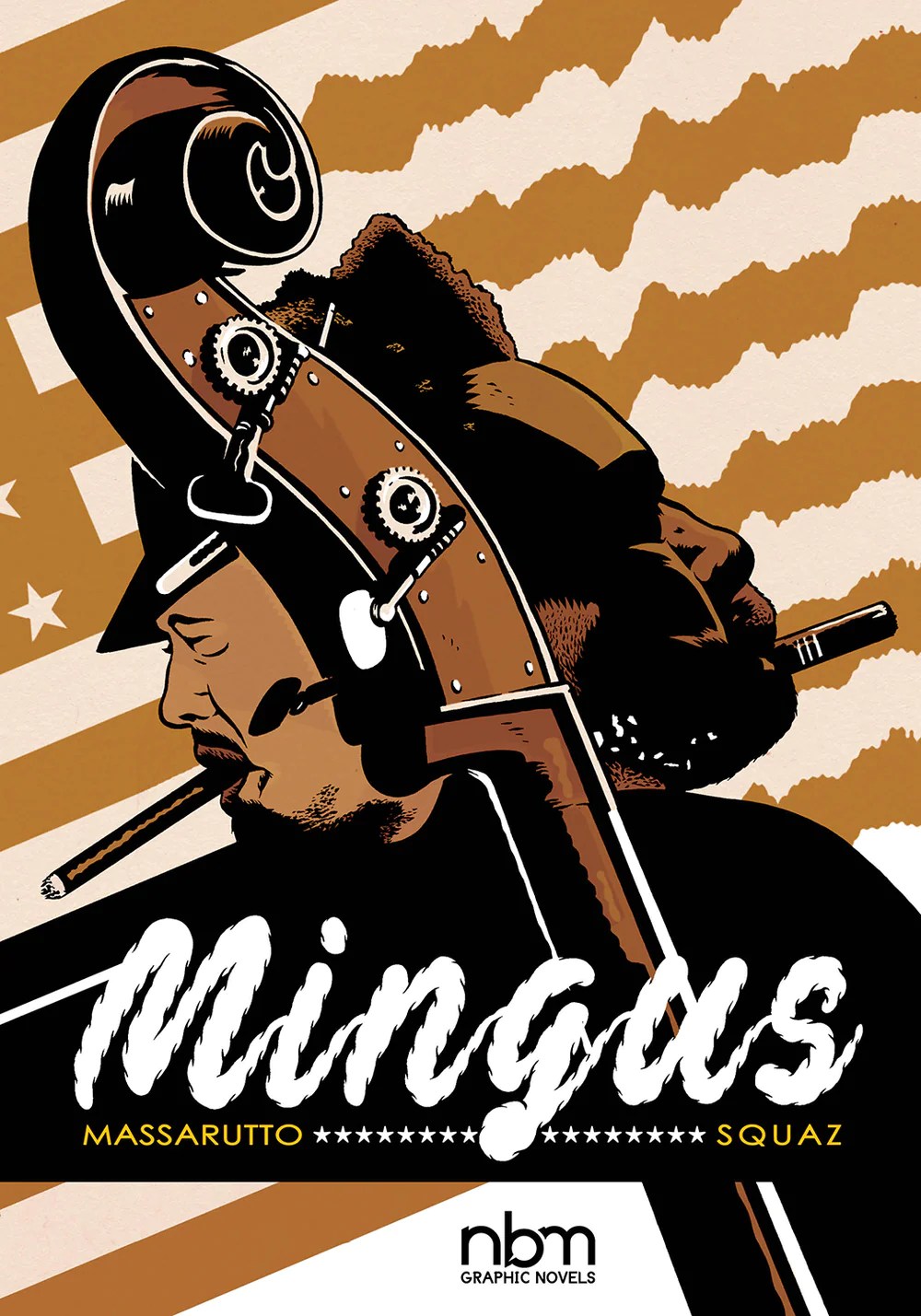
A good example of how the practice of victimization of the protagonist in graphic biographies of jazz icons constitutes a widespread and naturalized visual grammar is the comparison of the covers of the biographies of jazz legends Billie Holiday and Charles Mingus, both published by NBM – Graphic Novels.

The portrayal of the universe of Billie and Mingus, presents striking divergences in terms of the elements chosen to convey its essence. While certain aspects converge, such as the pervasive atmosphere infused with the smoke of cigarettes and cigars, the semiotic representations greatly differ in both covers.

The female figure is depicted in a state of desolation, completely devoid of any reference to her instrument, the voice, and reduced to a dramatic figure. In stark contrast, Mingus is rendered majestically, symbolizing power and authority in his musical prowess (and the reference to his instrument is there, too)

These observations are intended to remind us that comic books, like jazz, provide a lens through which we can examine and question the attitudes of society towards gender issues and, therefore, serve as important platforms for advocating gender equality and challenge preconceived notions about gender roles.

Be seeing you!

G.F.

This is the sixth part of a series of articles on the relationship between jazz and comic books. Go to Part 1 , Part 2, Part 3, Part 4 or Part 05

Comics and jazz were considered marginal forms of expression for a long time. However, they reached the 21st century with the status of artistic languages and are a recurring subject of academic theses and dissertations. Despite the different points of intersection between comics and jazz, to what extent has academic recognition caused a distance between the popular origins of these languages and the transformation of an audience of readers and listeners into collectors?

The recognition of comics and jazz as artistic languages by the academic community has undeniably elevated their status and led to a deeper exploration of their cultural and historical significance. As these art forms have become the subjects of scholarly research and academic discourse, the focus has shifted towards understanding their intricate connections with society, history, and other forms of art. However, this academic recognition has also raised important questions about the potential distance it may have created between the popular origins of comics and jazz and the transformation of their respective audiences into collectors.

On the other hand, the academic recognition of comics and jazz has indeed prompted a transformation in the dynamics of their audiences. While the popular origins of these art forms were deeply rooted in mass appeal and accessibility, their academic validation has led to a reconfiguration of their audiences. The transition from casual readers and listeners to discerning collectors has been influenced by the scholarly emphasis on the artistic, cultural, and historical significance of comics and jazz.

This shift has created a nuanced layer of appreciation among the audienced of comic art and jazz, with a growing focus on preserving and owning significant works within these art forms, altering the dynamics between creators, audiences, and collectors.

So that we can better understand what is at stake in this debate, let us first turn to the concept of cultural industry, a term coined by Theodor Adorno and Max Horkheimer. In his 1968 article, Adorno states that the cultural industry (…) forces the union of the domains, separated for millennia, of superior art and inferior art. To the detriment of both*

This thought-provoking statement encourages us to critically examine the implications of such amalgamation, as it raises pertinent questions about the intrinsic value and purpose of art in the modern cultural sphere.

The distinction between high and low culture has been a recurring topic in discussions within the field of Cultural Studies. Raymond Williams, a prominent British popular culture critic, addressed this dichotomy, noting that the so called “high culture” tends to remain largely unchanged over time (an concrete example of this phenomenon can be observed in the realm of classical music), while popular culture plays a pivotal role in facilitating the flow of information among diverse social groups, thereby engendering the emergence of novel and dynamic cultural expressions.

The word “flow” in jazz resonates with the interconnectedness of the melodic, harmonic, and rhythmic elements, contributing to the seamless and cohesive expression of the art form, but “flow” is a fitting descriptor for the organic development of the music, as well. It aptly captures the essence of a musical movement that is essentially born in motion and displacement. This fluidity is fundamental to the improvisational nature of jazz, where musicians dynamically interact and respond to each other, creating an ever-evolving musical narrative.

Applied to comic books, “flow” is a very useful concept for understanding the integration between visual narrative and the progression of the script and highlights the intricate fusion of visual and narrative elements. It is also crucial for the reader to semiotically fill the space between frames, completing the comic narative, but the aspect of flow we would like to highlight is related to the black diaspora and its influence on both forms of expression: comics and jazz.

Flow, in this context, has to do with a dynamic exchange of cultural, artistic and linguistic elements.

The fusion of African and European musical traditions resulted in several music genres that would become identity marks, such as during the formation of choro and samba in Brazil and Argentine tango, in the 19th century (as we will see in the last segment of this series of articles) and jazz in the 20th century USA.

Likewise, the influence of the black diaspora can be seen in comic books, both from a consumption point of view, given the fact that black audiences have been prominent consumers of comic books since the 1940s, as well as when it comes to the representation of the characters. In fact, the history of the representation of black characters in comic books would be a good summary of the history of racism itself.

Since the 1990s, the black diaspora has been given new meaning in the visual arts through Afrofuturism, which presents offers a way out of the marginalization imposed by European canons. However, with regard to the representation of the biographies of jazz stars in comics, in particular, the model that usually prevails is still far from ideal, and if it manages to go beyond the dehumanization of the past, it stil reaffirms tereotypes, reinforces victimization and the cult of marginalization.

Be seeing you!

G.F.

* “Résumé über Kulturindustrie” in Theodor W. Adorno, Ohne Leitbild: Parva Aesthetica. Frankfurt am Main, Sührkamp Verlag 1968, p.60-70.

** A Vocabulary of Culture and Society. Raymond Williams. New York. Oxford University Press. 1976

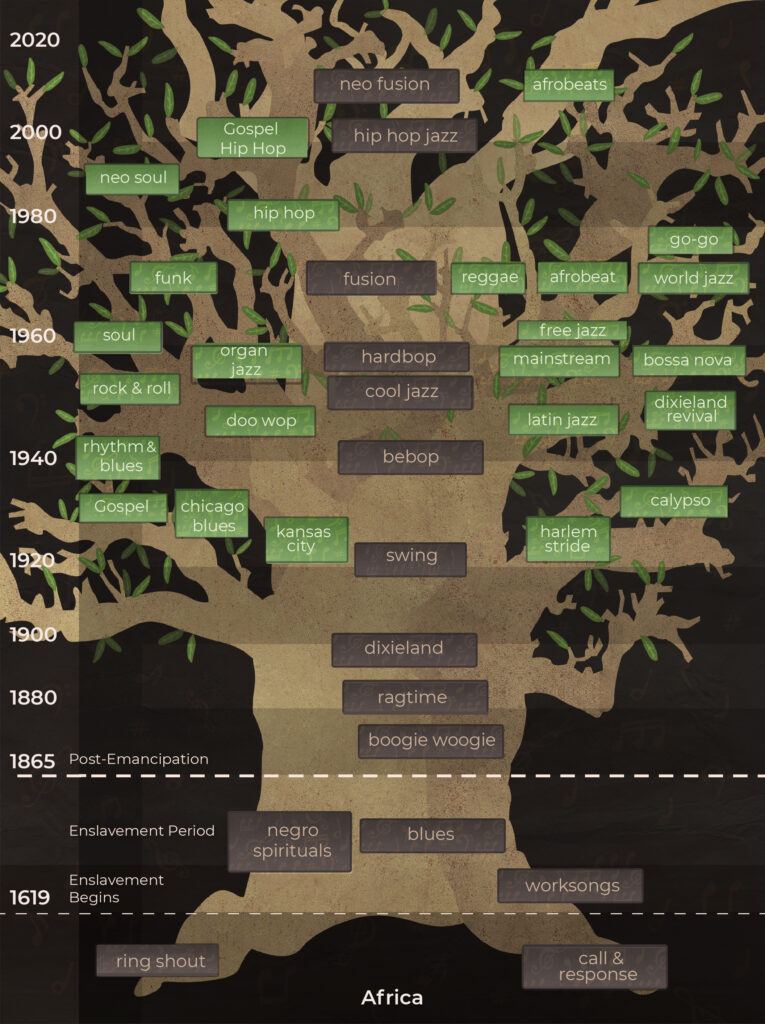
p.s. before you go, check this one version of the jazz tree. Beautiful, isn´t it?

THE LEGACY OF BLACK ANCESTRY: THE JAZZ TREE